
Lead Safe Mama, LLC’s 2025 Top Slow Cooker Pick — a Discussion with XRF Test Results






Published: November 2025
A Note from Tamara Rubin
Section #1) Introduction & Background
If you have been following the work of Lead Safe Mama, LLC over the past decade plus, you will know that we had reluctantly shared about the Instant Pot products being the lowest-Lead slow cooker type/ Crock-Pot-like countertop cooking appliance we had found through XRF testing — yet that it still tested positive for Lead (at concerning levels) in at least one component.
While the Instant Pot component with the heaviest Lead contamination is not a food-contact surface, it is a surface and structure that wears with use over time. The Lead-contaminated component is the interior heating element base of the appliance — the part that the stainless insert sits on top of. It is a semi-porous aluminum material that appears to be coated with a gray-painted/ enamel-type Titanium Dioxide-based coating.
The component posing the primary Lead concern for the Instant Pot is not a food contact surface; however, our stance here at Lead Safe Mama, LLC is that we, societally, in 2025-almost-2026 need to aim for completely Lead-free cookware. This should be a non-negotiable point as an end goal. This makes sense not only from a user’s perspective, but also from the perspective of environmental protection. Any component of a product with any appreciable amount of Lead is an item for which its manufacture contributes to Lead mining and refining (or the recycling of Lead and/or Lead-contaminated materials such as recycled aluminum), with the manufacturing process using Lead or other Lead-contaminated materials. These are all activities that can contaminate the environment (air, water, soil, including environments where food is grown, etc.) and thus cause exposure to humans globally (whether or not the specific end-product causes direct Lead-exposure to the end user of that product).
We have written several articles discussing this concern about the Lead contamination in the Instant Pot, noting that, while it is Lead-contaminated, it had still been the lowest level of Lead we had found in a product like it at the time (with independent XRF testing) — UNTIL NOW.
As all aluminum-based substrate heating elements in these types of counter-top cooking appliances have been similarly contaminated, we have always said it would be a bit of a “Holy Grail” of an opportunity for a company to create a product with next-to-no contamination of the heating element base for this type of appliance. To accomplish this, the manufacturer would need to find a source of Aluminum that is not heavily Lead-contaminated. This means they would most likely need to use virgin Aluminum — not recycled Aluminum, which is more likely to be contaminated.
The secondary issue (in addition to the Lead-contaminated heating element) with many of these countertop plug-in cooking appliances (or similar stovetop appliances for pressure cooking or slow cooking) is that the valves in the lids are often also made of heavily Lead-contaminated materials (even — and especially — on the food contact side). This is not the case with the Instant Pot, but it has been the case with other products and brands we have tested (rice cookers, slow cookers, pressure cookers, etc. — see our list with some relevant examples below).
Given our experience testing these products using XRF technology (since 2009, going on nearly 17 years now!), when we are evaluating these types of appliances for toxicant contamination concerns, we first want to know how clean (or how contaminated) the heating element tests. Then, our second main concern is whether or not the product has valves (in the lid or elsewhere) that may be made out of materials other than Stainless Steel. Most of the valves for this type of appliance are made of either Lead-contaminated Aluminum or heavily Lead-contaminated brass. Antimony and Cadmium (two other carcinogens) are other contaminants we look for in these cookware products, as both can be a concern for the food contact surfaces on many of these product types.
Luckily, the new Washington State Law limiting Lead in all components of metal cookware goes into effect in January of 2026, and we are excited that this may help clean up the industry in years to come. We have, however, unfortunately seen very slow movement with the State of Washington when it comes to ramping up enforcement actions for its recent toxicants legislation in other areas, so we are not holding our breath for that to happen!
Section #2) Additional Test Results Supporting the Concern for Lead Contamination in Small Countertop Appliances & Similar Cookware
Below are links to several articles we have written with examples of Lead-contaminated products we have tested that fall within the above-noted product categories. There are many more pieces here on the site, but these are just a representative sample showing the range of Lead contamination in these types of products.
- Instant Pot
- 617 ppm Lead — Heating Element
- 7,129 ppm Antimony — Electrical Cord
- Pioneer Woman Instant Pot
- 8,195 ppm Antimony — Electrical Cord
- 443 ppm Lead & 642 ppm Cadmium — Heating Element
- Miracle Rice Cooker
- 5,484 ppm Lead & 1,481 ppm Antimony — Electrical Cord
- 2,850 ppm Lead — Heating Element
- VitaClay Slow Cooker (expressly advertised as Lead-free!)
- 70,400 ppm Lead — Interior of Heating Chamber (non-food-contact surface)
- 71 ppm Lead — Food Contact Surface of Cooking Vessel
- 321 ppm Lead — Heating Element
- KitchenAid Slow Cooker
- 386 ppm Lead — Black Ceramic Liner, Food-Contact Surface
- Butterfly Brand Pressure Cooker (India)
- 6,412 ppm Lead & 12,000 ppm Lead — Steam Vent Components
- Butterfly Brand Slow Cooker (India)
- 120,500 ppm Lead — Interior Food Contact Surface Steam Vent
- Rival Crock Pot (Vintage)
- 120 ppm Lead — Food Contact Surface
- 14,000 ppm Lead — Power Cord
Section #3) It looks like we may have found the Holy Grail of Slow Cookers!
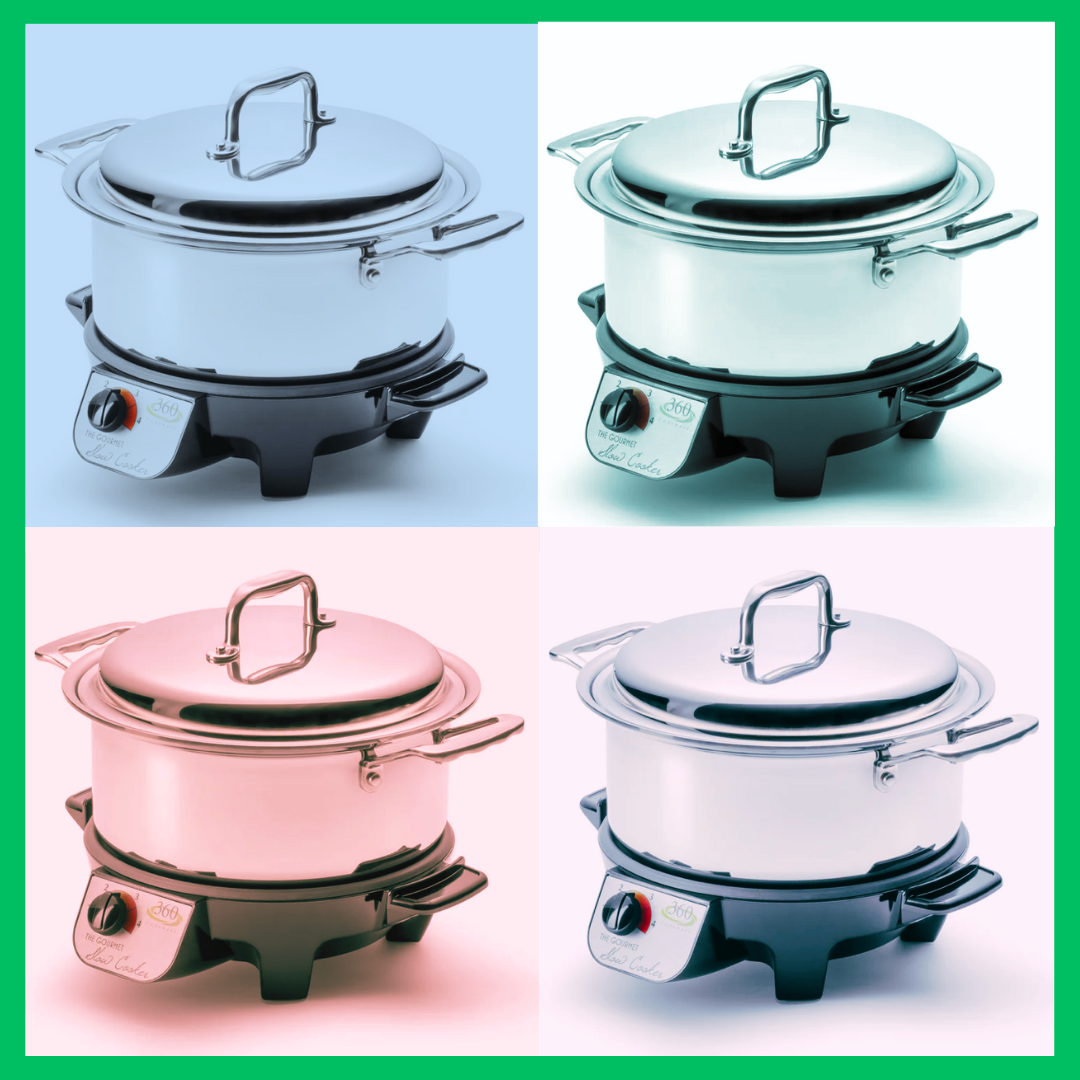
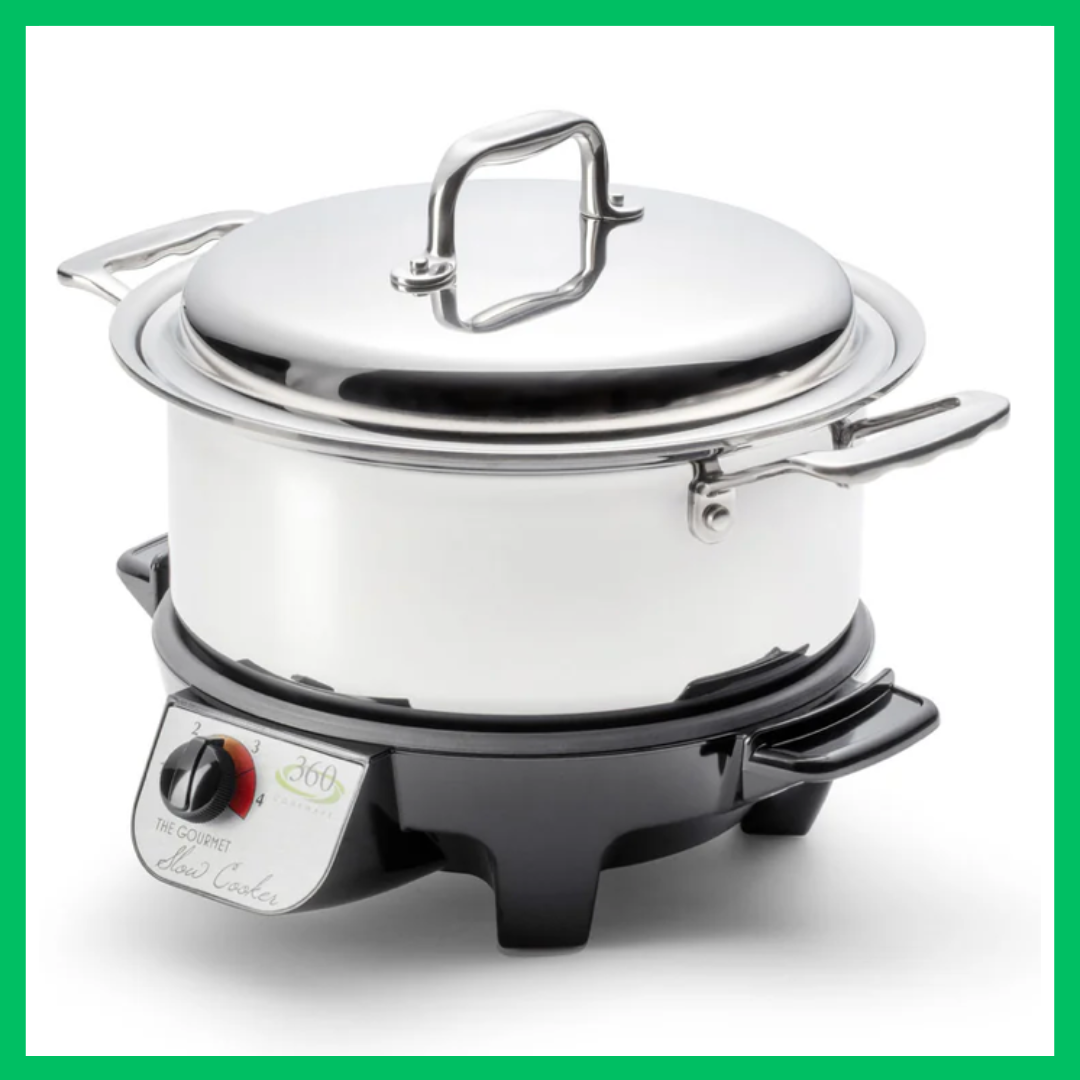
For me, an analogy to the Holy Grail here is appropriate: It’s something hard to find, something valuable to many, something of extreme importance to many, and something rare and unusual. It is with this preface that I present the 360 Cookware Slow Cooker as this Holy Grail of Slow Cookers, in so many respects. It’s not 100% perfect, but it is near perfect. It is the closest to perfect we have found to date, which is why I invited 360 Cookware to become a sponsor of Lead Safe Mama, LLC’s work after having the opportunity to test several of their products. You can read more about that here.
What’s so great and unusual about the 360 Cookware Slow Cooker?
- We have always recommended cooking in a combination of cookware — specifically a mix of vessels, including uncoated high quality stainless steel (the highest quality you can afford), uncoated cast iron, and clear (uncoated/ unpainted) glass. You can read more about this here.
- As the food contact surface (the cooking vessel) of the 360 Cookware Slow Cooker is made of high quality stainless steel (really, an heirloom quality likely to last a lifetime or longer), it meets our first criteria noted above.
- There are no valves, other additional components, or decorative elements on the functional stainless steel cookware components of this product (the pot and the lid). The pot and lid for this 360 Slow Cooker are entirely stainless steel — so there are no components that might potentially leach contaminants like Lead, Cadmium, Mercury, or Arsenic into your food (a full XRF test result set for the food-contact stainless steel component of this slow cooker is below).
- Find more on the concern for Lead-contaminated additional elements that are often added to cookware (for fashion or function) here. (Please note that valve considerations are discussed in some of the articles linked above, in Section #2.)
- The unique functional design of this product creates a Vapor® Cooking seal, resulting in there being no need for potentially Lead-contaminated valves or other components.
- Last but not least, the heating element of this slow cooker is the cleanest heating element for any similar appliance that we have ever tested. While there are very low traces of Lead and Cadmium in this Aluminum cooking base (scroll down to see full XRF test results), the levels are in the low double-digit range (under 15 ppm), far lower than anything we have seen previously. Prior to this, the slow cooker heating elements we have tested typically ranged from 300 ppm Lead to 3,000 ppm Lead or even higher.
- The level of Lead legally allowed in an item intended for use by children is 90 ppm in the paint, glaze, or coating, or 100 ppm in the substrate (base material). This is the strictest regulatory standard for Lead content in consumer goods. Even though this is not an item intended for use by children, with “less than 15 ppm Lead,” this heating element is therefore safe by ALL standards — including those designed to protect the health and well-being of children.
- In addition to the level being incredibly low (again, lower than any other functionally comparable product on the market), the owners of 360 Cookware (Beth and Bryan) have made a commitment to bring that level “closer to zero” in future batches, agreeing to work with Lead Safe Mama, LLC in an advisory capacity by having us test and evaluate possible materials prior to manufacturing future iterations of the product in support of the quest to make an entirely Lead-free cooking base.
- To reiterate: The levels found are extremely low, they are also levels that are considered safe by ALL standards (including the standards applied to items intended for use by children). There is no other product with heating element toxicant levels this low (that we are aware of).
- Bonus: The product is also lovely to look at, and very beautifully designed, but that’s a trivial consideration when compared to the points noted above.
I think the most important thing to highlight with the 360 Cookware brand as a whole is that this company is run by real people who really care. These are people that want to make the best possible product and they are using all of the resources they can find to make it possible. This is a rare quality to find in a manufacturer and I am thrilled that Lead Safe Mama, LLC is partnering with 360 Cookware (they have joined us as a newsletter sponsor and advertising partner as of November 2025). Without further ado, please continue reading below to see the full XRF test results for the 360 Cookware Slow Cooker product.
360 Cookware is also currently having a 30% off Black Friday sale you may want to check out. Here’s the Lead Safe Mama link to the Black Friday sale for this slow cooker.
Note: This is not a Nickel-free product. If you have a diagnosed Nickel allergy or sensitivity, this may not be the best product for you. We’re hopeful that 360 Cookware will consider making a Nickel-free version sometime soon!
Section #4) XRF Test Results for the 360 Cookware Slow Cooker
All XRF readings are repeated multiple times to confirm the test results. One full set of readings for each component tested is listed below.
Reading #1) Inside Food Surface of Cooking Pot
60-Second Reading
Stainless Steel #316
- Lead (Pb): non-detect
- Cadmium (Cd): non-detect
- Mercury (Hg): non-detect
- Bromine (Br): non-detect
- Arsenic (As): non-detect
- Chromium (Cr): 168,500 +/- 1,100 ppm
- Vanadium (V): 945 +/- 261 ppm
- Manganese (Mn): 13,500 +/- 800 ppm
- Iron (Fe): 689,800 +/- 1,800 ppm
- Cobalt (Co): 2,812 +/- 954 ppm
- Nickel (Ni): 102,200 +/- 1,300 ppm
- Copper (Cu): 859 +/- 180 ppm
- Molybdenum (Mo): 21,000 +/- 200 ppm
- Tin (Sn): non-detect
- Gold (Au): non-detect
- No other metals detected in Consumer Goods Mode
Reading #2) Heating Element Surface
60-Second Reading
- Lead (Pb): 14 +/- 8 ppm (safe by all standards)
- Cadmium (Cd): 11 +/- 5 ppm (safe by all standards)
- Mercury (Hg): non-detect
- Bromine (Br): non-detect
- Arsenic (As): non-detect
- Chromium (Cr): non-detect
- Manganese (Mn): 9.629 +/- 452 ppm
- Iron (Fe):4,417 +/- 258 ppm
- Cobalt (Co): 2,701 +/- 961 ppm
- Nickel (Ni):956 +/- 88 ppm
- Copper (Cu): 949 +/- 63 ppm
- Zinc (Zn): 139 +/- 21 ppm
- Tin (Sn): 17 +/- 8 ppm
- Platinum (Pt): 336 +/- 46 ppm
- Balance: Aluminum
- No other metals detected in Consumer Goods Mode
Reading #3) Electrical Cord
60-Second Reading
- Lead (Pb): non-detect
- Cadmium (Cd):18 +/- 6 ppm (safe by all standards)
- Mercury (Hg): non-detect
- Bromine (Br): 17 +/- 4 ppm
- Arsenic (As): non-detect
- Chromium (Cr): non-detect
- Manganese (Mn): non-detect
- Iron (Fe): 756 +/- 144 ppm
- Copper (Cu): 156 +/- 36 ppm
- Zinc (Zn): 197 +/- 26 ppm
- Niobium (Nb): 616 +/- 24 ppm
- Indium (In): 34 +/- 8 ppm
- Tin (Sn): 17 +/- 9 ppm
- Antimony (Sb): 610 +/- 24 ppm *(very low for an electrical cord!)
- Platinum (Pt): 95 +/- 40 ppm
- Cobalt (Co): non-detect
- Nickel (Ni):non-detect
- Molybdenum (Mo): non-detect
- No other metals detected in Consumer Goods Mode
Reading #4) Rubberized Foot Insert of Plastic Platform
60-Second Reading
- Lead (Pb): non-detect
- Cadmium (Cd): non-detect
- Mercury (Hg): non-detect
- Bromine (Br): non-detect
- Arsenic (As): non-detect
- Chromium (Cr): non-detect
- Iron (Fe):743 +/- 38 ppm
- Zinc (Zn): 208 +/- 11 ppm
- Barium (Ba): 300 +/- 117 ppm
- No other metals detected in Consumer Goods Mode
Reading #5) Black Plastic Base of Platform
60-Second Reading
- Lead (Pb): non-detect
- Cadmium (Cd): non-detect
- Mercury (Hg): non-detect
- Bromine (Br): non-detect
- Arsenic (As): non-detect
- Chromium (Cr): non-detect
- Iron (Fe): 2,698 +/- 74 ppm
- Zinc (Zn): 551 +/- 20 ppm
- Titanium (Ti): 583 +/- 320 ppm
- Barium (Ba): 388 +/- 128 ppm
- No other metals detected in Consumer Goods Mode
Reading #6) Plastic of Plug (at end of Electrical Cord)
60-Second Reading
- Lead (Pb): non-detect
- Cadmium (Cd): non-detect
- Mercury (Hg): non-detect
- Bromine (Br): non-detect
- Arsenic (As): non-detect
- Chromium (Cr): non-detect
- Zinc (Zn): 531 +/- 46 ppm
- Antimony (Sb): 1,474 +/- 42 ppm*
- Barium (Ba): 441 +/- 79 ppm
- Chlorine (Cl): 360,000 ppm
- No other metals detected in Consumer Goods Mode
*Antimony is added as a flame retardant to all modern electrical cords on appliances for which there is a potential fire risk. The Antimony levels in the electrical cord and plug for this slow cooker are relatively low compared to the levels found in other similar modern appliances.
Additional Related Reading
- Our “Stainless Steel” Article Category
- Our overview article for how to choose safer pots and pans for your family
- Our “What is Stainless Steel” Article
- Our “Why does some Stainless Steel have a Prop 65 warning label on it” Article

Never Miss an Important Article Again!
Join our Email List
That’s a crazy amount of money to pay for a slow cooker. No way would I ever pay that much. A lot of people won’t.
It’s a lifetime / heirloom quality purchase – and there is also a 30% off sale happening now – if that helps. It’s also a great gift to give new / young families, since they will likely have it forever.
T
It is a crazy amount of money, but, to be fair, she’s not saying everyone should go and buy it. She’s saying that it tested non-detect for lead so that readers can decide for themselves what they want to buy (or avoid) with the information she’s making available.
The reason the others are cheaper is because they use cheaper and contaminated materials in countries without regulation. Unfortunately, it now costs a lot of money to avoid those contaminants. We have also gotten used to the cost of throw-away products.
It is all certainly a personal choice based on finances, etc. I, personally, don’t have the money to be avoiding all of the things I want to avoid right now. However, having had multiple parents in homes/facilities due to dementia/strokes where they could no longer be cared for at home, and how it’s drained everyone’s retirement, I have a different perspective on what my health costs now.
You can almost buy a whole stove for that price
Isn’t that the truth!
I would buy it, but I STILL wish that somebody would come up with alternatives to antimony in chords etc… look how close we are to finally having a completely safe product…. just a bit more human ingenuity or stop freaking out about fire ratings I guess… if your house is on fire it’s probably not due to an electrical chord… and all that antimony isn’t going to save you.
Does “heating element surface” refer to the exposed surface that the pot sits on? Or is it a more internal component? Thank you!
The surface the pot sits on. For context the only relevant standards (which are not applicable), is toys are considered hazardous to children with Lead levels over 90 ppm, and Cadmium levels over 40 ppm (Wa State Standard).
So this is truly safe by all standards – including the most rigorous standards for toys.
T
I don’t see a reading for the handles or the front part of the cooker with the knob and colored design surrounding the knob. Also, what is the rubberized foot insert? (you usually have photos next to each reading)
Have you tested inserts for any brand new crock pots?
Is there pfas in the surface of the slow cooker base? What is the coating made of
I don’t believe it is coated. We only test for metals.
T
Question about this rec for a slow cooker…in at least one of your posts, you indicate that acidic food should never be cooked for hours in stainless steel. Can you kindly explain if this file cooker is safe to use with acidic foods since we use our crockpot for things like chili that take all day to cook? Really appreciate you and your work!
I still stand by that. I think – fundamentally – we should re-examine any cooking we are doing that takes so long (like all day). However as I have said previously, if you are going to do that type of cooking you want to make sure to cook in the highest quality cookware of that type that you can afford (to limit leaching). This product fits in that category (well made, high quality) – and I still recommend limiting long-form cooking (especially long form cooking with tomato sauce).
t
Thank you so much for the quick reply. We love making vegan chili and will have to look at alternate ways of doing so. Appreciate you!
I think the Instant pot is a great way to prep beans without long-form cooking. You may even be able to do it with shorter cooking times in the 360 Slow Cooker – I will ask my husband. He makes vegan stews and soups all the time (using either this 360 cookware product or the Instant Pot).
T
That would be amazing to know how he cooks these things. We use our Instant Pot all the time mainly for beans 🙂
Hi Tamara,
My husband and I are vegans as well, and we both would also love to know how your husband cooks his beans and stews in the 2 different cookers! We have both of the cook-pots as well. Thank you
Have you tested the Magnifique claypot slow cooker?
No.