


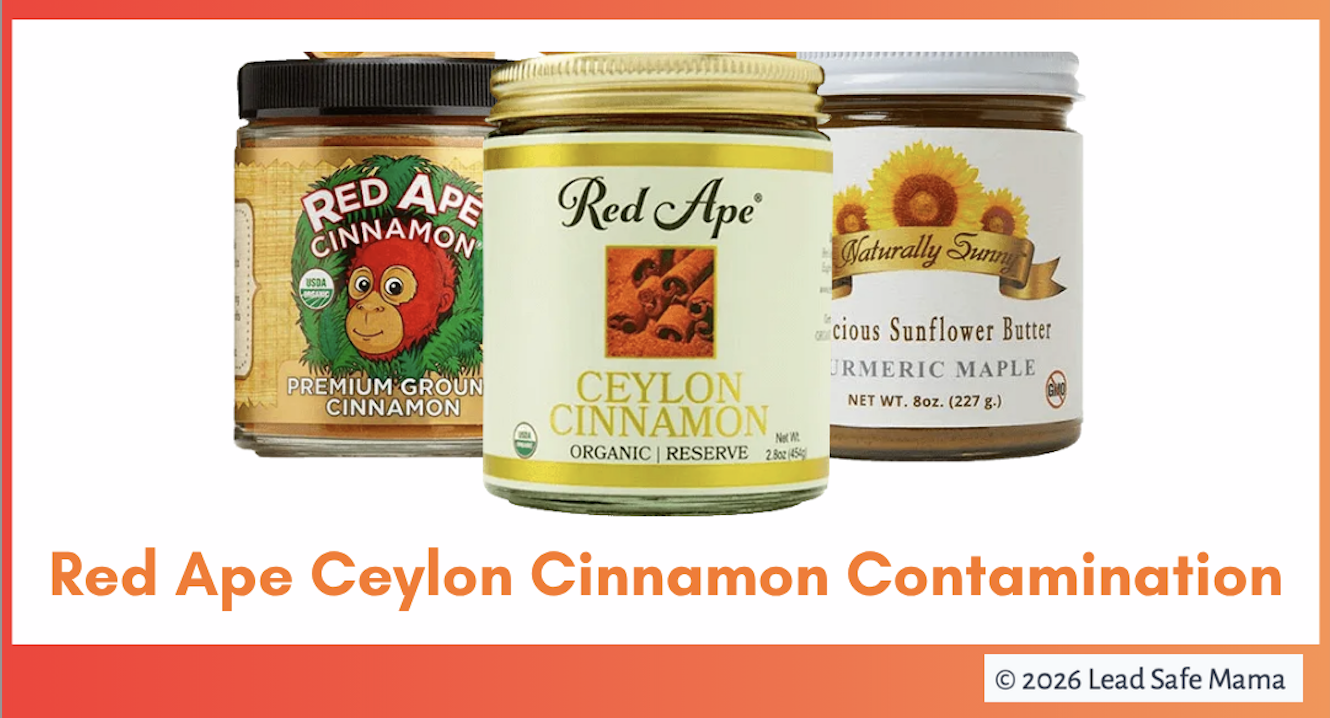
Yes, Red Ape Ceylon Cinnamon Is Also Contaminated.




Published: April 30, 2026
A Quick Note From Tamara Rubin
We often get questions about Red Ape Cinnamon — and we got a few more in response to this article published earlier today, link here — so we decided to finally share some thoughts on that in a short article and social media post.
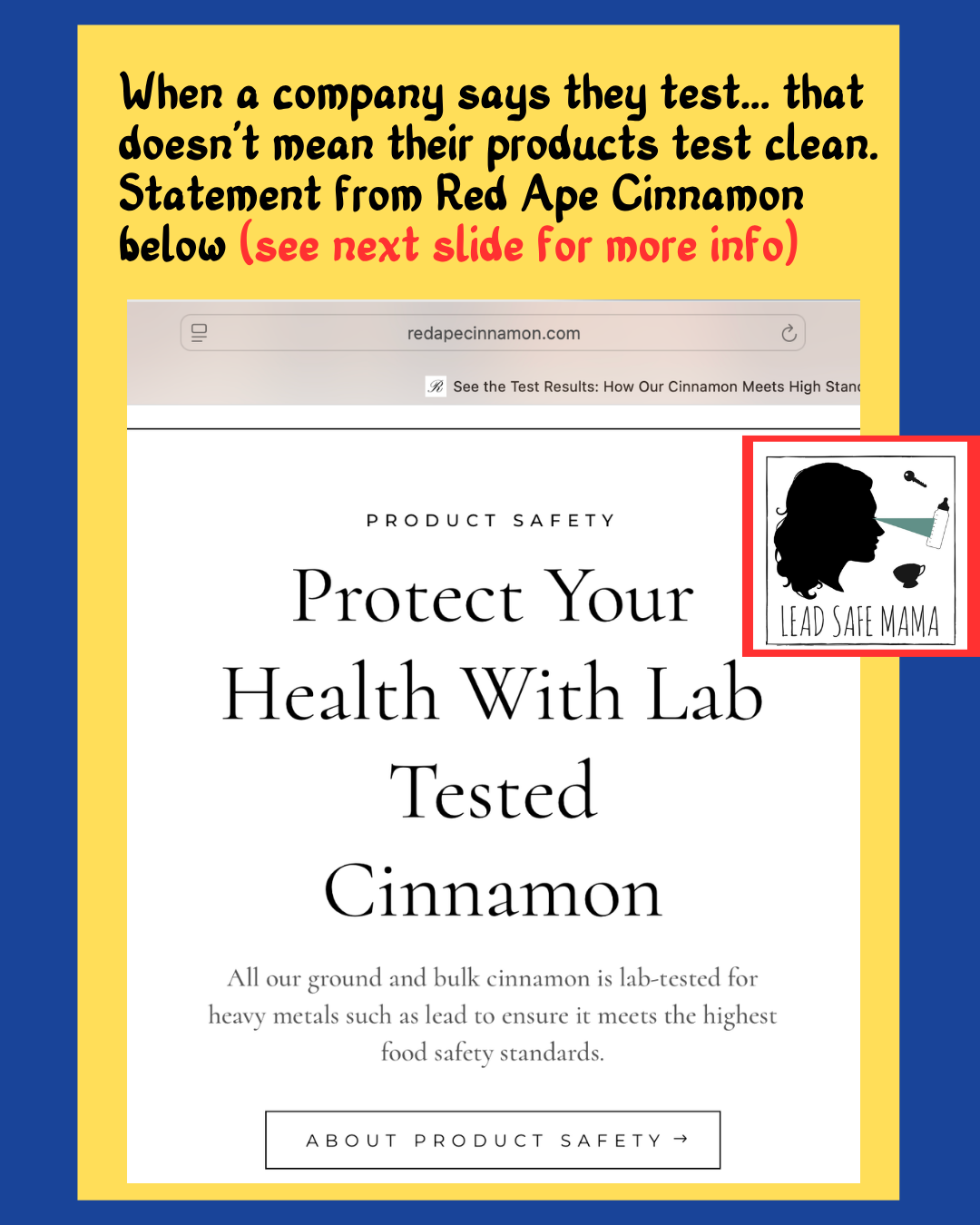
Consumers frequently misinterpret Red Ape’s statement that they “Lab Test for Heavy Metals… to ensure it meets the highest food safety standards” (see graphic below) to mean that these Red Ape Cinnamon products are FREE FROM heavy metals. This is not the case. The Red Ape Ceylon Cinnamon products are positive for concerning levels of heavy metals, just like all other Ceylon Cinnamon products currently on the market today.
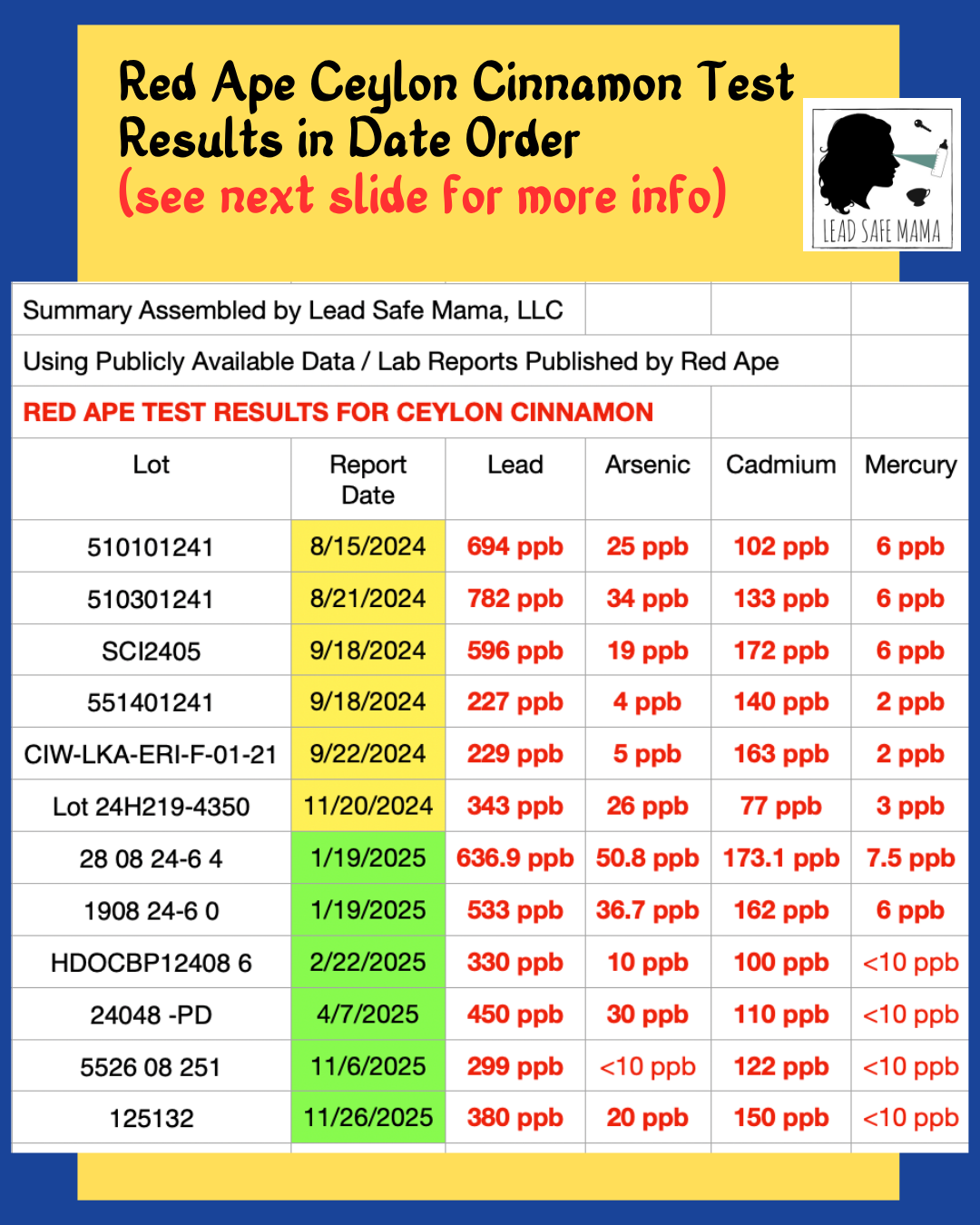
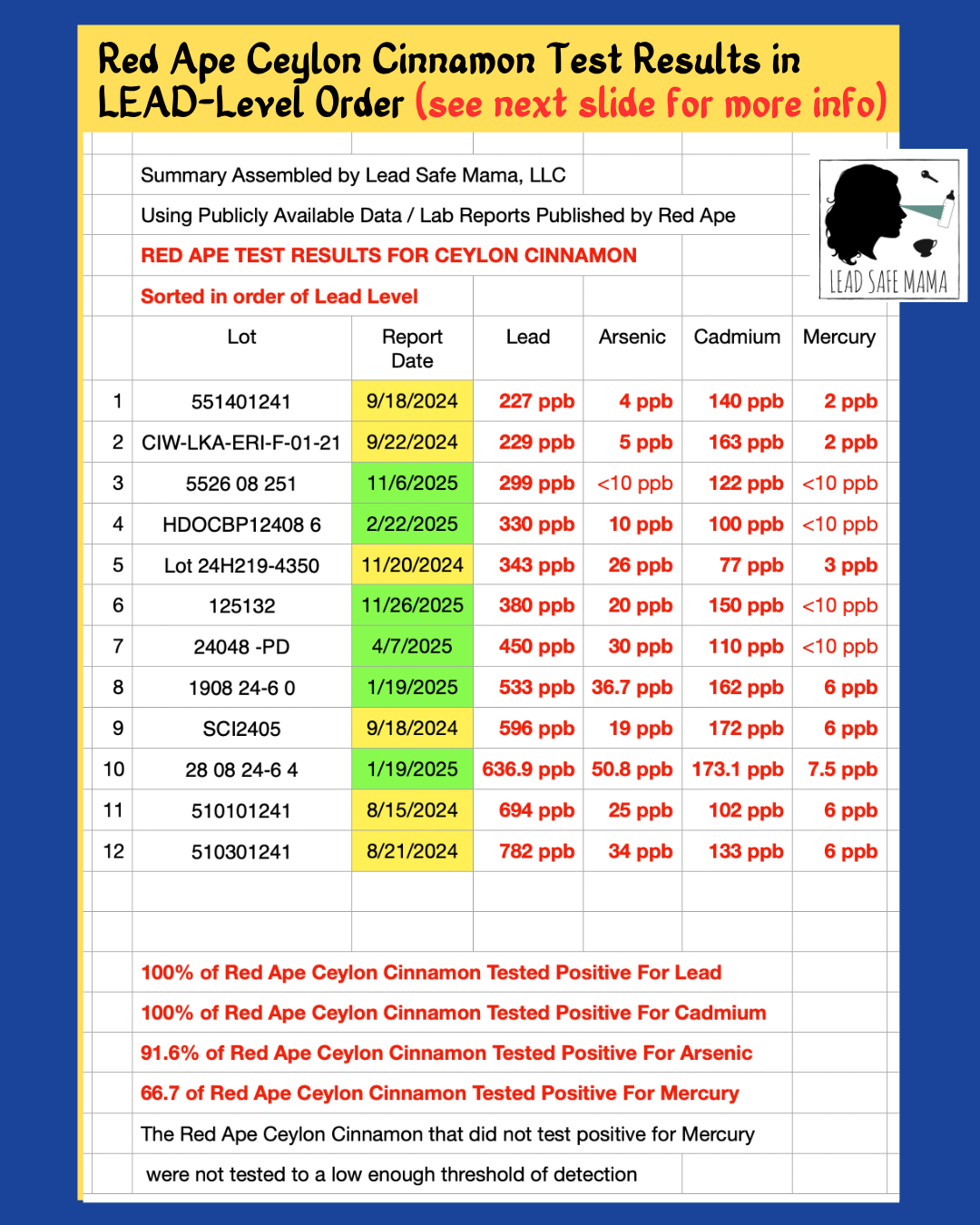
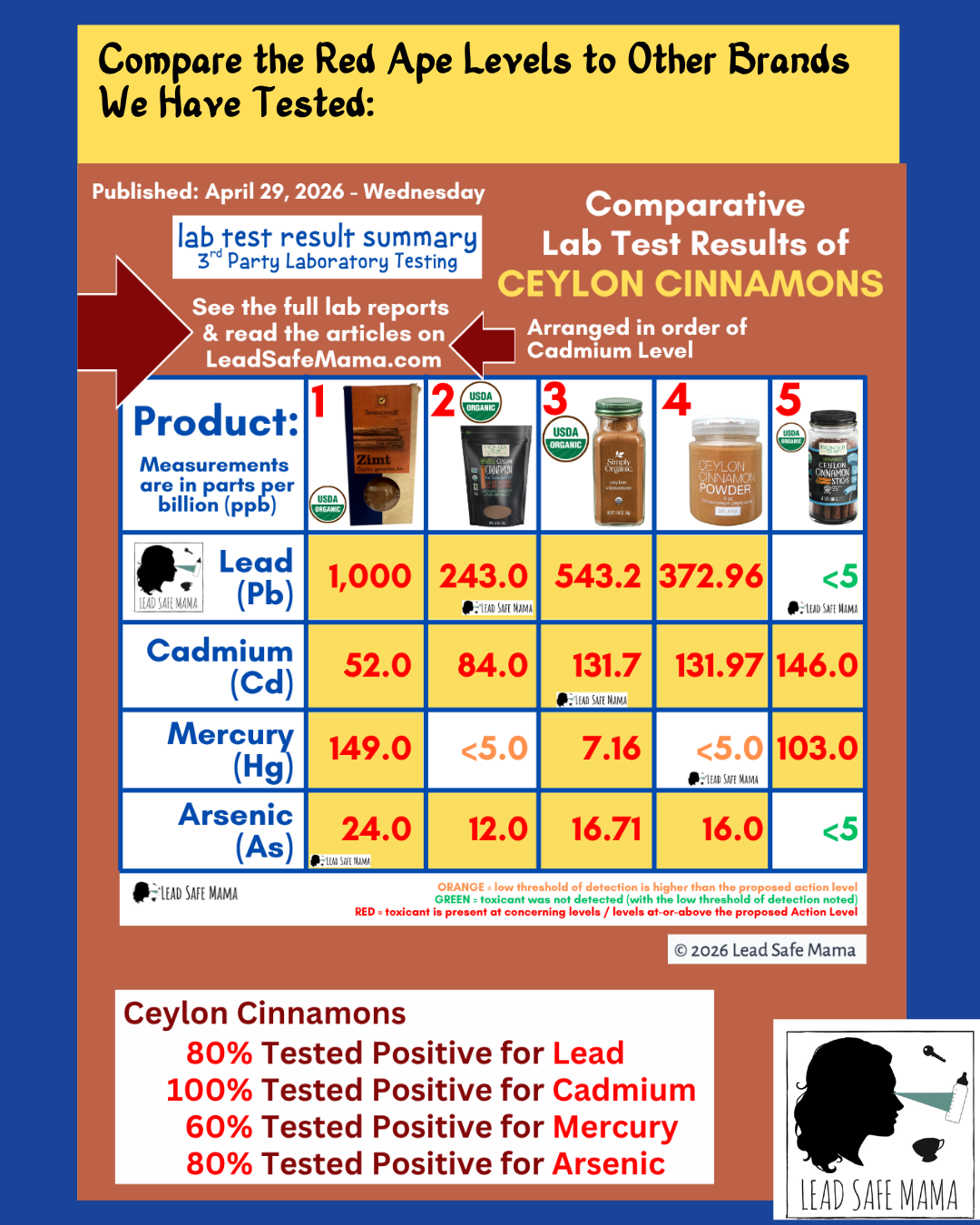
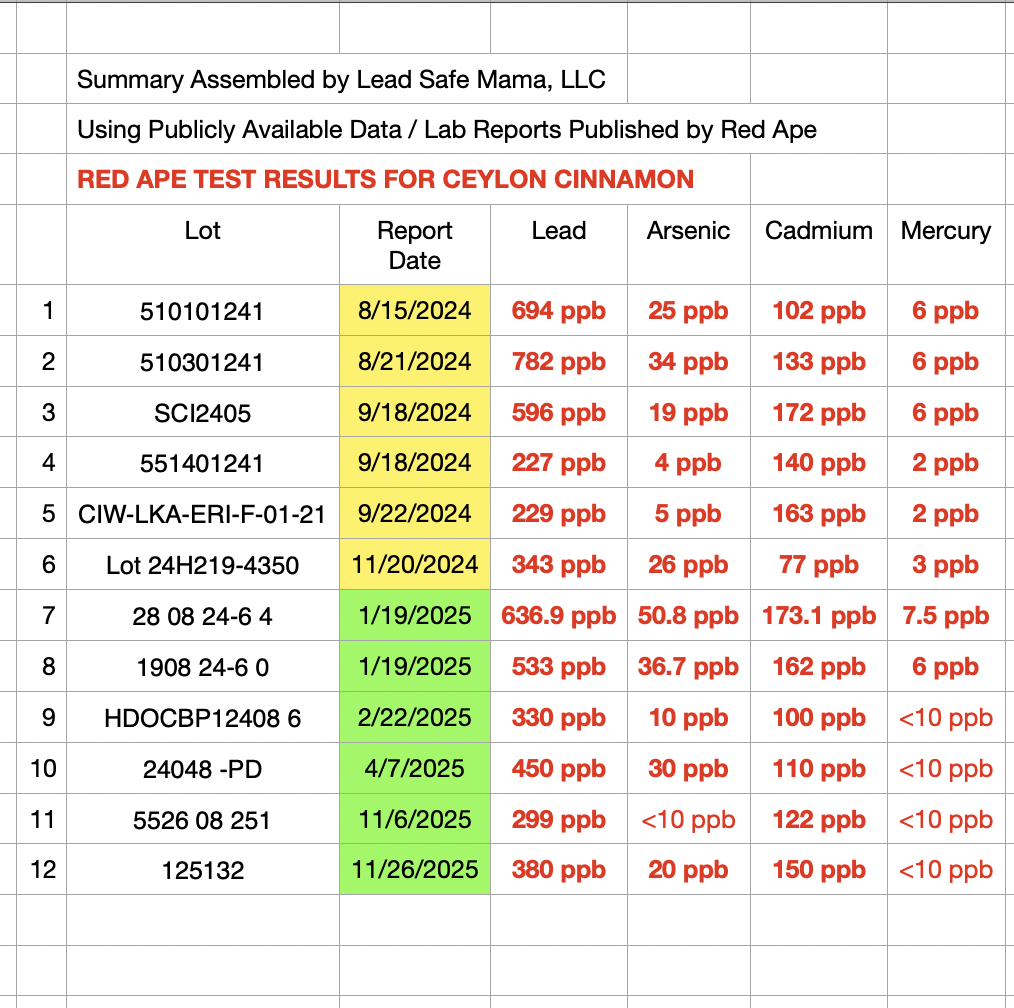
We created the four images below to share about the concern on social media earlier today (link to our Instagram post can be found here if you would like to join in the discussion, or share that on your Instagram page. Here’s the link to the post on Facebook too). Below that are links to Red Ape’s full original lab reports that they publish and share on their website. As those lab reports are where we got the data from for the charts below, we wanted to include those here as well — however (as of the date of publishing this article) they can all also be found directly on Red Ape’s website.
I think it is great that Red Ape tests their products and it’s also great that they publish their lab reports in the name of transparency — HOWEVER — those lab reports just reinforce our position that Ceylon cinnamon should not be consumed by human beings until the industry has figured out how to clean up their crops / how to significantly reduce the toxicant levels in cinnamon.
We also have an issue with Red Ape’s marketing in that so many people have come to us with the misunderstanding that the Red Ape products are free of heavy metals. Here’s a comment we got today (that inspired me to write this analysis) as an example:
“If a brand like Red Ape is claiming it’s free of contaminants, how can we actually verify that?”
This person BELIEVES that Red Ape is claiming that their products are free of contaminants (specifically based on the language Red Ape uses, even though they never expressly say their products are free of contaminants!) This belief is generated and curated — crafted by the company. The consumer has been led to believe this even in the absence of statements asserting this specifically.
Given how often we are asked this exact question about this brand, this common misunderstanding truly appears to be the intention behind Red Ape choosing specific statements (about health, quality, and purity) that can be easily misunderstood (following a playbook laid out by many other product manufacturers).
If you also had this understanding about this brand (assuming that it was heavy metals free), please comment with your thoughts here on this article in the comment section below. If you had not yet heard of this brand of products, please read the first image below and let us know what your first impression is — based on their language.
This misunderstanding is created expressly because of the words that Red Ape chooses to use in their marketing, even though they do not expressly state that their products is free of heavy metals.
The intention behind Red Ape’s greenwashed marketing: I expect that most consumers read the words “Protect Your Health With Lab Tested Cinnamon” – see image below – and they trust the “transparency factor” that is implied with that language. Consumers then don’t bother to take the time to actually read and understand the lab reports (after all lab reports are not easy to understand if you don’t have a background in the issue). It would appear that Red Ape is either relying on the fact that people won’t check the lab reports OR relying on the fact that consumers will not understand the lab reports (which all have results expressed in parts per million instead of parts per billion – to further hide the concern, making the test results numbers for heavy metals seem small/trivial!) It’s also possible that the people at Red Ape (owners, managers, marketing folks) actually believe their messaging and don’t understand their own lab reports themselves — but I think that is the least likely scenario.

Key Relevant Points
- All relevant federal agencies (EPA, FDA, CDC, etc.) have published statements in agreement with the consensus in the scientific and medical communities that there is no safe level of Lead exposure. You can see those statements on this link here.
- 100% of Red Ape Ceylon Cinnamons tested positive for Lead (per their own reported testing).
- 100% of Red Ape Ceylon Cinnamons tested positive for Cadmium.
- 66.7% of Red Ape Ceylon Cinnamons tested positive for Mercury.
- 91.6% of Red Ape Ceylon Cinnamons tested positive for Arsenic.
- Several of the Lead test results of the Red Ape Ceylon products actually have Lead levels that are higher than most of the other Ceylon Cinnamon products we have tested and reported on.
- Red Ape’s most recent (November 2025) Ceylon Cinnamon lab report shows a Lead level of 380 ppb. That level is higher than 60% of the other brands of Ceylon Cinnamon that we have tested to date.
- Red Ape’s most recent Ceylon Cinnamon lab report also shows a Cadmium result of 150 ppb — this Cadmium level is higher than the Cadmium level for 100% of the other Ceylon Cinnamons Lead Safe Mama, LLC has tested and reported to date.
- Their most recent (November 2025) testing for Arsenic show’s Red Ape’s Ceylon Cinnamon product tested positive for a level of Arsenic that is higher than 80% of the other Ceylon Cinnamon products we have tested to date.
- The above points clearly indicate that while Red Ape does test, they are by no means the cleanest Ceylon Cinnamon product available — however this factoid is irrelevant (as is any effort made to try to determine which Ceylon Cinnamon is cleanest or safer) as ALL Ceylon Cinnamon products contain unsafe levels of one or more heavy metals.
NOTE: all of the levels shown for these Ceylon Cinnamon products are 100% legal, the problem is that there are no laws with health-protective limits for toxicants (specifically heavy metals) that one might find in cinnamon. The laws that do exist are “industry-protective”, not “human-health-protective”.
- Lab Report 1
- Lab Report 2
- Lab Report 3
- Lab Report 4
- Lab Report 5
- Lab Report 6
- Lab Report 7
- Lab Report 8
- Lab Report 9
- Lab Report 10
- Lab Report 11
- Lab Report 12

Never Miss an Important Article Again!
Join our Email List
I actually recall reading on their site months ago that they acknowledge there is some lead in all their cinnamons AND they said that Ceylon cinnamon consistently tests higher in lead than the cassia cinnamon does. When I read their info originally I felt like that was transparent and appreciated that they didn’t pretend to have no heavy metals in there…
My big question for my own family’s kitchen is, if we are sparingly use cinnamon occasionally (like we’re going to make pumpkin pie with cinnamon), how can I at least get my hands on some cinnamon that isn’t the worst offender. (Until we HOPEFULLY find a clean one eventually. Though it seems to me the chances of that are looking slim for the foreseeable future.)
Based on my research I felt that red ape cassia cinnamon fit the bill for my thanksgiving pie or whatever else I might want use cinnamon for a few times a year. ♀️
Hi Hadasah,
Did you read the stats below? Red Ape has higher Cadmium levels than any other Ceylon cinnamon we have tested and reported on to date. Check out the other stats along those lines in the “Key Points” summary.
Cadmium is a known Carcinogen. You can read more about that here: https://tamararubin.com/2026/02/colonoscopy/
T
I use their turmeric sometimes so looked up test results. They only list mg/kg but easy to convert to ppb multiplying by 1000. Definitely above your safety levels for most heavy metals. Lead 150 ppb. Cadmium 220 ppb. Arsenic <100 ppb. Mercury <5 ppb
Thank you for commenting!
T