
Comparison Chart: Nuts, Seeds, Nut Butters, & Nut Flours

Published: November 30, 2025
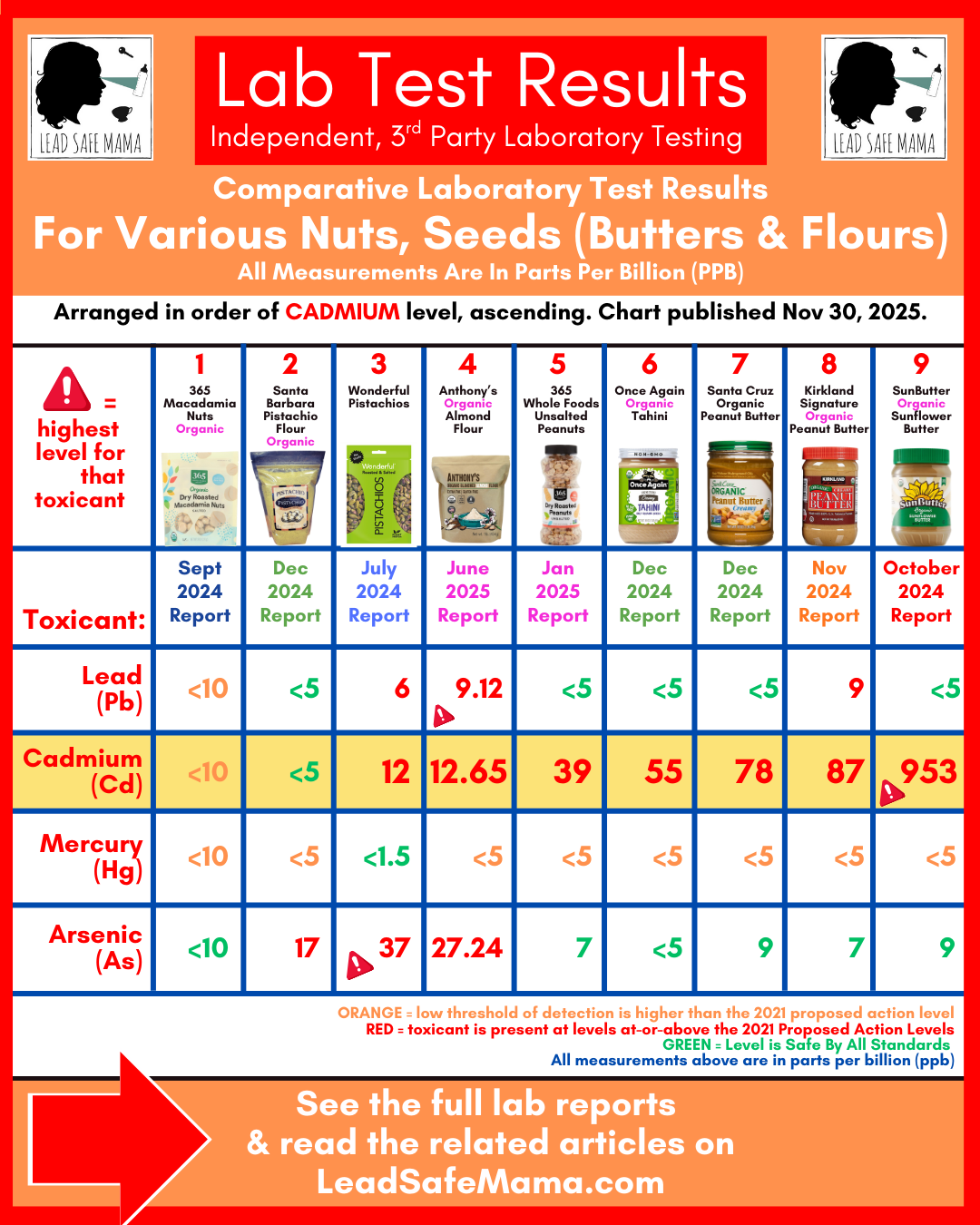
The graphic on this page is a chart designed to help you easily compare the toxicant levels found in nine different nuts, seeds, nut butters, and seed butter products (including tahini, sunflower seed butter, and peanut butter) that we have tested and reported on to date.
Below, you’ll find a list of linked articles containing the lab reports for each product included in this chart. The full original lab report is always at the very bottom of each article, AFTER the shareable social media graphic, and AFTER the list of lab-tested safer choices the Lead Safe Mama, LLC Community Collaborative Laboratory Testing Initiative has identified to date.
The products in this chart are arranged in ascending order of Cadmium levels. Cadmium is a known carcinogen and does not belong in our food supply. It is often found as a contaminant in food grown as ground crops, like peanuts, potatoes, and strawberries, where the edible parts of the plant are in direct contact with soil for much of the growth cycle. Some plants (like sunflowers) are particularly efficient at sucking up toxicants from the soil and carrying them to the parts of the plant we eat (sunflower seeds), even though that part does not come in direct contact with soil under normal growing conditions.
Key points to highlight based on the above data set:
- When the Baby Food Safety Act of 2021 was drafted, the proposed Action Level — at which there is too much of a substance in a product intended for consumption by babies and young children — for Cadmium was set at just five parts per billion (5 ppb).
- While the 5 ppb Action Level became the scientific and medical community’s recommendation at the time (given Cadmium was identified as a human carcinogen over 30 years ago, and its status as a carcinogen is not disputed at all), the Baby Food Safety Act of 2021 never passed into law.
- The USA currently has no legally enforceable total content limits (measured in ppb) for Cadmium in most foods (including many popular foods that children may eat on a daily basis — like peanut butter and SunButter).
- There are some guidelines and limits (specifically internationally) for Cadmium content in shellfish and chocolate products, as well as new regulations in 2023 for sunflower seeds and peanuts.
- For context, the European limit for milk chocolate candy that comprises less than 30% total cocoa mass is 100 ppb Cadmium.
- This 100 ppb limit is based on the assumption that chocolate candy is eaten relatively infrequently and in small quantities. For a food expected to be consumed more frequently and in higher quantities than chocolate candy (like SunButter!), one would expect a Cadmium limit lower than 100 ppb (that is, if the U.S. government bothered to regulate such food products, which it currently does not).
- You can read more about these chocolate limits here, and shellfish limits here.
- The European Union has set a 200 ppb Cadmium limit for peanut products and a 500 ppb Cadmium limit in sunflower seeds (read the 2023 regulation here).
- The limits for these products do not account for American consumption patterns (such as the food quantities Americans typically consume, especially American children).
- For example, Europeans consume far less peanut butter than children in the United States, where it is often a daily lunchbox staple.
- While even these European limits are not strict enough to be truly health-protective, they do provide context that highlights how extremely concerning the level of Cadmium we found in the SunButter product is.
- The limits for these products do not account for American consumption patterns (such as the food quantities Americans typically consume, especially American children).
- Peanuts & Peanut Butter: Given that every peanut and peanut butter product the Lead Safe Mama, LLC Community Collaborative Laboratory Testing Initiative has analyzed to date tested positive for Cadmium — usually at levels far above 5 ppb — it is our recommendation at this time that children not eat peanut butter, especially if there is a history of cancer in their immediate family (parents, grandparents, siblings, etc). You may evaluate these numbers and come to a different conclusion, deciding you are comfortable with the risk, but at least now you have some raw data to help you make that decision.
- Other nut butters are likely safer options — see Point 6, below.
- Sunflower Seeds & SunButter: We were simply astounded by the amount of Cadmium found in the SunButter product, and promptly filed a report with the FDA — although I do not believe any action has since been taken. Read our report, linked here.
- The level of Cadmium found in this product is extremely concerning, and no child should be eating any foods made with this product as a primary ingredient (cookies, sandwiches, etc).
- We understand this may present a hardship for some, but feeding your child a product (that many families choose as an alternative to peanut butter) with a documented extremely high level of a known carcinogen is simply not an option.
- Sesame Seeds: These are another ground plant crop (not a tree), so it makes sense they are also contaminated with Cadmium (please note the tahini test results featured in this chart).
- Tree Nuts: Based on the testing we have completed to date — and as evidenced by the data in the chart — other nut and seed butters are likely healthier, cleaner, safer alternatives to peanut butter and sunflower seed butter. Our assertion/ educated guess is that any tree nut (walnuts, almonds, cashews, macadamia nuts, pistachios, etc.) is a likely cleaner option, and we will continue exploring this further by testing more nuts, as we have the resources to do so. To support this theory, we’ve found the following examples:
- Organic Macadamia Nuts tested clean (although the lab we sent them to did not test down to low enough thresholds of detection, and we would like to retest this product).
- Organic Pistachios from the Santa Barbara Pistachio Company tested relatively clean. While only their pistachio flour is on the chart, we also tested their whole kernel pistachios and found identical test results to the flour product.
- While they tested positive for traces of Arsenic, the level was relatively low, likely from the groundwater on the farm where the pistachios are grown.
- This company also makes a Roasted Pistachio Butter, which is delicious and may be a good alternative for some if they don’t have a concern for Arsenic consumption*.
- Note: The conventional pistachios we tested (from the “Wonderful” brand) did not test clean.
- Organic Almonds tested positive for toxicants (in the Anthony’s Organic Almond flour we tested).
- As this is our only data point for a single-ingredient almond product so far, we need to conduct additional almond testing to determine whether almonds are generally contaminated.
- It is possible that the almond flour product we tested is contaminated with the levels of metals found (in whole or in part) as a result of processing almonds into flour.
- If had to guess, I would expect Arsenic to be present in the plant/growing process, and I would expect that at least some of the Lead and Cadmium contamination is possibly the result of processing.
- To Recap: We are recommending avoiding/not consuming peanut butter, or peanut products in general (including peanut-flavored products). We are also recommending that sunflower seed butter should NEVER be consumed, especially not by children or pregnant women (as well as those with a history of cancer in their family). We are recommending using tree-nut butters instead, such as cashew butter, pistachio butter, almond butter, macadamia butter, walnut butter, etc.
Reminder: There’s no safe level of Lead exposure for human beings. Please do take that into account in your decision-making process. The chart on this page is arranged only by the level of Cadmium found — it does not take Lead levels into account. We are expressly not recommending Anthony’s Organic Almond Flour or Wonderful Pistachios, as each tested positive for concerning levels of Lead.
Some additional reading that may be of interest:
Nut, Seed, Nut Butter, Nut Flour Articles with Lab Reports
- 365 Organic Whole Foods Market Macadamia Nuts — Not Yet Published
- Santa Barbara Pistachio Company, Pistachio Flour — Organic
- Wonderful Pistachio Nuts — Conventional
- Anthony’s Organic Almond Flour
- 365 Whole Foods Market Unsalted Peanuts — Conventional
- Once Again Tahini (Single-Ingredient, Sesame Seeds) — Organic
- Santa Cruz Organic Peanut Butter
- Kirkland Signature Organic Peanut Butter
- SunButter Organic Sunflower Seed Butter
What now? My family has been regularly consuming some of the more toxic products in this chart!
If you or your children have consumed any of the more toxic products in this chart on a regular basis, and if you therefore have concerns about ongoing Cadmium exposure (given Cadmium is a known carcinogen), please consider reporting the product to the FDA. FDA Complaints from consumers who have actually used these products carry a lot more weight than complaints we file as an organization.
Here’s the link to file an FDA Complaint: https://www.accessdata.fda.gov/scripts/medwatch/index.cfm?action=reporting.home

Never Miss an Important Article Again!
Join our Email List
Any chance you might test TerraSoul Organic Almond Flour (https://www.amazon.com/Terrasoul-Superfoods-Organic-Almond-Flour/dp/B0BWLBRV4V/ ) and more PB Brands? Here on the E. Coast we buy Wegman’s Organic PB and Full Circle Organic brand (both in the glass jar)–perhaps those could be tested. Thanks always for all you do!
Envirokids Peanut butter cereal is on the Lead Safe Mama “Safer choices list”. I’d sure like to know how they manage that. Clearly not all peanut butter is contaminated? I literally did call and ask their source for peanut butter, but they say it’s proprietary and will not disclose.
It’s not a peanut butter – it’s a peanut butter flavored cereal. There is probably very little peanut butter in it. Corn is generally not at all contaminated or not very contaminated (most corn things we have tested have come back relatively clean).
T
Hello.i dont see any report on sesame seeds.did you ever test them?
Here’s a Sesame Seed Product:
https://tamararubin.com/2024/12/once-again-organic-tahini/
T
Gotcha. It tastes/smells strongly of PB to my PB-loving family, so it’s surprising. Seems similar foods which are also merely “flavored” with other high risk ingredients, like chocolate, have never tested clean. (Ingredients: whole grain corn meal*, corn meal*, cane sugar*, peanut butter*, soy oil*, sea salt, and tocopherols (vitamin E)) *Contains peanuts and soy.)
WOULD LOVE TO TRY THE SANTA BARBARA PISTACHIO NUTS, BUT THE SHIPPING IS OUTRAGEOUS. WILL MISS ENJOYING PISTACHIOS.
Oh – I wasn’t aware of how much the shipping was, I know they are expensive. They were delicious. I might have gotten a bag or two for myself after we tested them 😉 – Even though they are not perfect it’s nice to know we are not eating Lead with them!
T
The Santa Cruz Peanut Butter is a bummer… we use it, as it is at least organic and comes in a glass jar… not sure we can do much better until these companies start to get pushed to do better, or one in a million actually care.
Hi Tamara , What about Adam’s peanut butter in glass jars? And i wish so much that you couldtest the glass on these .I over the years have collected these jars and reuse them for food leftovers. Could these be toxic? Would be so great to hear from you. Thank you.
I don’t expect the jars are problematic – but all peanut butter should be considered problematic at this point.
Hi Tamara, Could you kindly post a list of the safe and acceptable nut or seed butters, as well as beans, rice, quinoa and oats, to help all of us find a safer way of eating. I would truly appreciate your help. What other resources are available for us to search these things as well? Thank you soo much! You are awesome!!
There really isn’t a list for exactly what you are looking for – but we have a few relevant lists that may be helpful.
Read this:
https://tamararubin.com/2026/02/colonoscopy/
Check out all of the articles on this page too:
https://tamararubin.com/food/
Read this too:
https://tamararubin.com/safer-choices/