Comparative Test Results For Four Bobbie Infant Formula Products — Tested In 2026




Published: April 11, 2026
This article discusses Lead Safe Mama, LLC’s independent, third-party lab test results for Bobbie Infant Formula products, as well as context related to the State of Florida’s recent reporting of lab test results of these same products.
Hey friends!
–
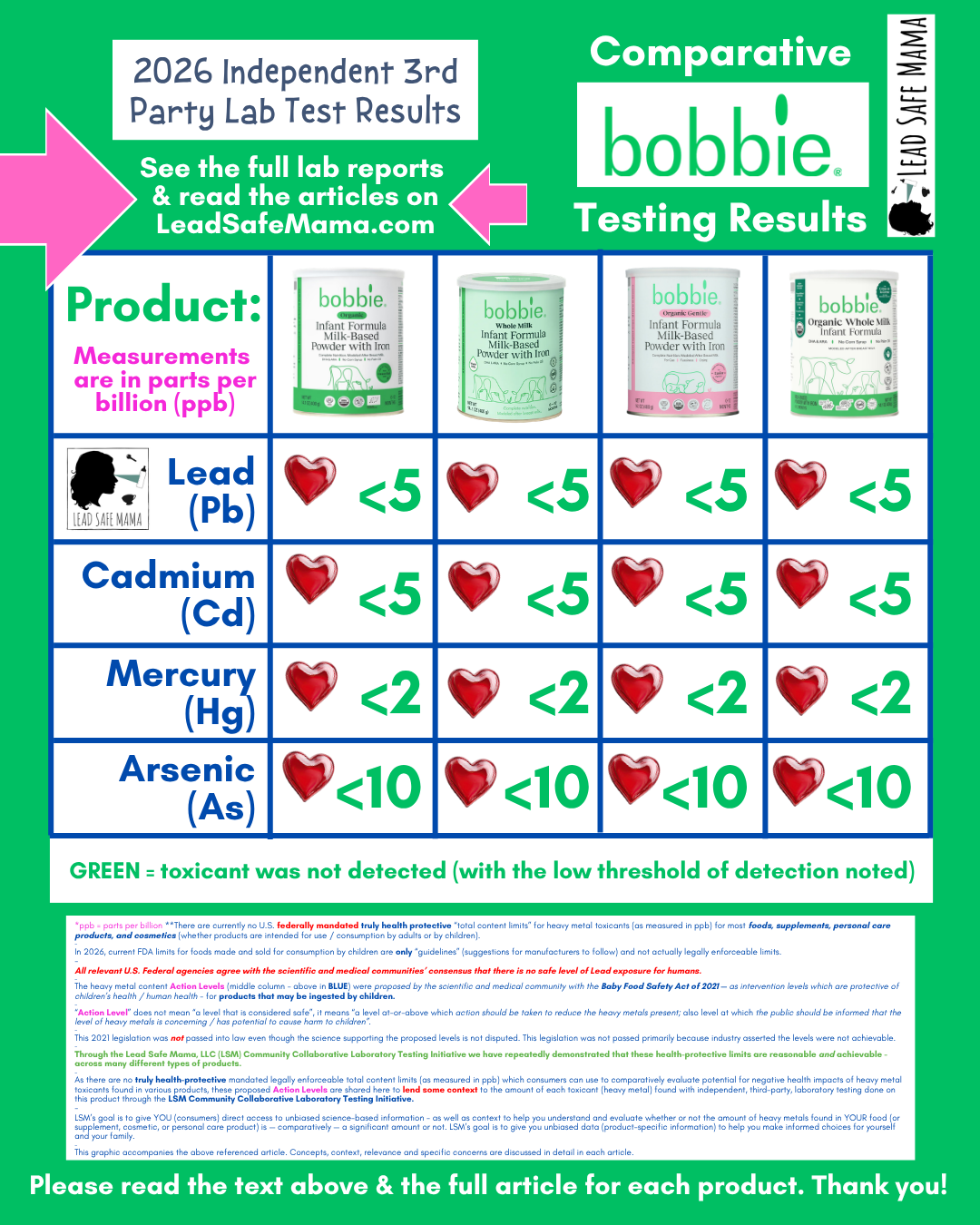
We published FOUR new lab reports for Bobbie brand infant formulas this week. Each of these products tested clean (woot!), and with even lower low-thresholds of detection that what we typically test down to (we were able to get these tested down to a threshold of 2 ppb Mercury).
–
As you can see in the comparative chart above, all four Bobbie brand infant formula products came back:
- “non-detect” for Lead,
- “non-detect” for Cadmium,
- “non-detect” for Arsenic, and
- “non-detect” for Mercury…
- ….with testing done through the Lead Safe Mama, LLC Community Collaborative Laboratory Testing Initiative.
Bobbie sponsored this testing (at our invitation), so we could have these products tested quickly (given our last testing on the Bobbie brand infant formula products was done in November 2024 and they were due for a re-test).
–
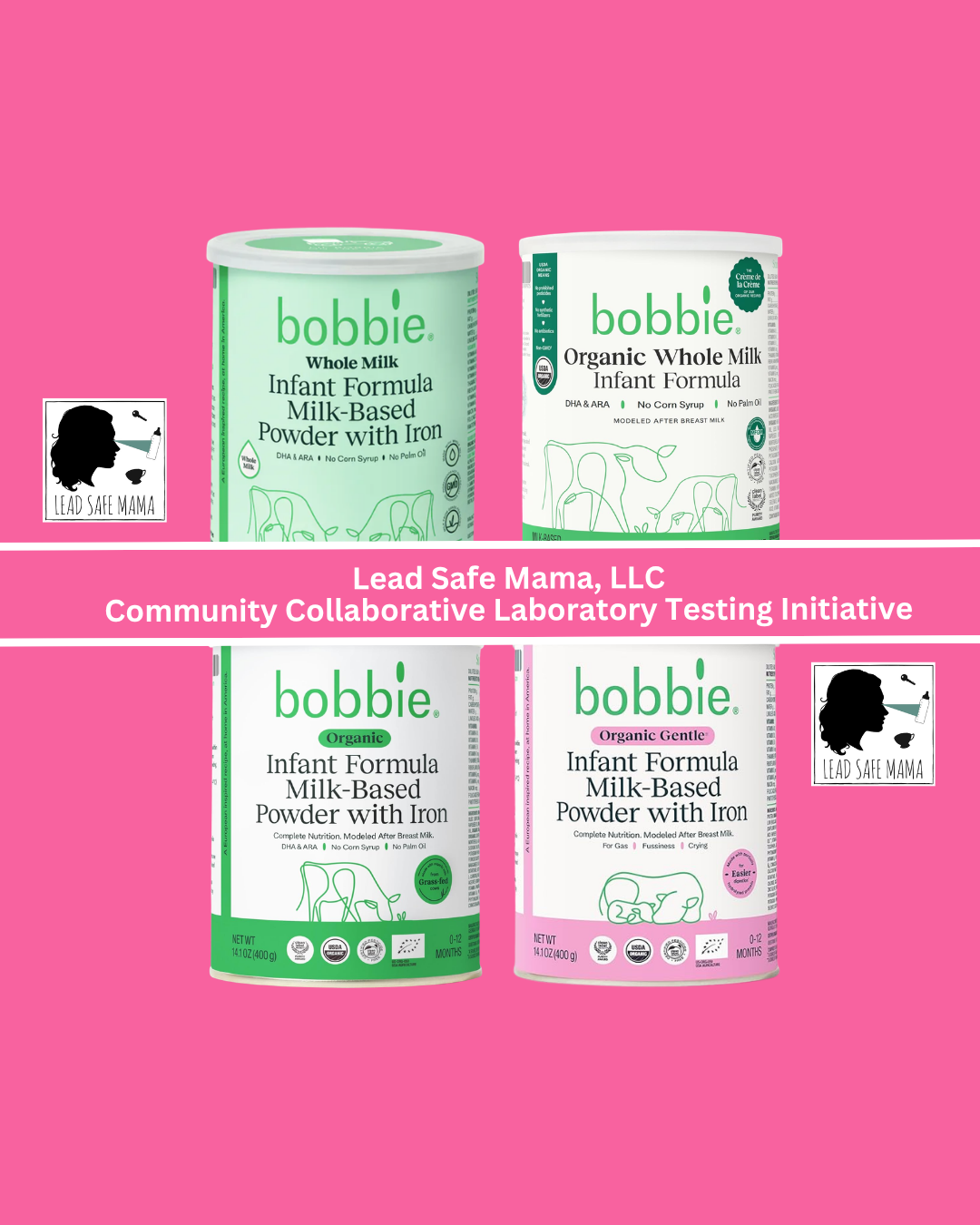
Here are Amazon links for each of the four products:
–
1.) https://amzn.to/4ciafK2 – Bobbie Organic Gentle Infant Formula
2.) https://amzn.to/48eH0qH – Bobbie Organic Whole Milk Formula
3.) https://amzn.to/4chiEgR – Bobbie Organic Milk-Based Formula Powder with Iron
4.) https://amzn.to/4cBcc5H – Bobbie Whole Milk Infant Formula Milk-Based Powder With Iron
–
If any of the links to the products (above) show the product is sold out – it may be in stock on the company’s website or in your local brick-and-mortar store.
–
The links to the articles with the full original lab reports for each of the four products are below. The full original lab report for any given product can always be found at the very bottom of the article for that product, simply click the link and scroll down!
–
1.) Bobbie Organic Whole Milk Infant Formula:
https://tamararubin.com/2026/04/bobbie-organic-whole-milk-infant-formula/
–
2.) Bobbie Organic Milk-Based Powder with Iron:
https://tamararubin.com/2026/04/bobbie-organic-infant-formula-milk-based-powder-with-iron/
–
3.) Bobbie Whole Milk Infant Formula Milk-Based Powder with Iron
https://tamararubin.com/2026/04/bobbie-whole-milk-infant-formula-milk-based-powder-with-iron/
–
4.) Bobbie Organic Gentle Infant Formula Milk-Based Powder With Iron
https://tamararubin.com/2026/04/bobbie-organic-gentle-infant-formula-milk-based-powder-with-iron/
–
Thank you for checking out these links!
A More Detailed Discussion of Our Testing of the Bobbie Powdered Infant Formula Products
Section #1) Background:
- While Bobbie sponsored the cost of the testing and reporting of these four powdered infant formula products they did not influence our testing and reporting in any way.
- We purchased each of the products tested at full retail value from different sources (so that Bobbie did not have any influence over which specific batches of products we tested).
- Samples of each of the products were sent to the lab “blind” in medically sterile containers (not in the original packaging), so even the lab did not know which brand of infant formula we were testing and reporting on.
- Bobbie understood that by sponsoring our testing and reporting on these products we would report the lab test results regardless of the outcome (good or bad — meaning we would report the lab test results even if these products tested positive for toxicants [heavy metals]) Their sponsorship therefore had no influence on our reporting.
- While Lead Safe Mama, LLC has a commitment to re-test and report on the products listed on our Lab Tested Safer Choices List annually (or more often) as funds permit, we did not yet have the funds to re-test the variants of these products that we had tested and reported on back in November of 2024. Consequently Bobbie’s sponsorship this year made it possible for us to retest these products quickly (without our standard approach which would have required raising funds from the community via a crowd-funded GoFundMe campaign or similar effort — which can take many months).
- While Bobbie did cover the costs for the Lead Safe Mama, LLC testing and reporting of their products (per our budget, here), we have no other financial relationship with this company.
Section #2) The importance of testing to a low threshold of detection of 2 ppb Mercury
- Testing and reporting of products to date (through the Lead Safe Mama, LLC Community Collaborative Laboratory Testing Initiative), have – with a few exceptions – consistently had a low threshold of detection for Mercury of 5 parts per billion (ppb).
- This means that our “non-detect” results for Mercury for most products we have tested and reported on to date would read “non-detect, less than 5 ppb”. So the level of Mercury could be any level under 5 ppb.
- As the Baby Food Safety Act of 2021 had set an “Action Level” of 2 ppb Mercury for foods that may be consumed by babies and young children — we expressly wanted to get these formulas tested down to the lowest possible “low threshold of detection” for ALL four heavy metals — including Mercury, so we could confirm if – in fact – this formula product was safe by ALL standards, including the standards proposed (but not passed into law) in 2021 with the Baby Food Safety Act.
- Industry push-back (food industry in general), has often asserted that achieving levels below the 2021 proposed Action Levels is not possible and that their products should not be regulated to these levels (should not be required to be cleaner than these levels). Those levels are:
- 2 ppb Mercury
- 5 ppb Lead
- 5 ppb Cadmium &
- 10 ppb for non-speciated Arsenic
- Our testing of many products to date has clearly demonstrated that achieving these levels (with test results for many classes of products falling below the proposed action levels noted above) is achievable.
- It is important to understand that the proposed “Action Levels” are not to be considered an “Acceptable Level” or an “Allowable Level” (or extrapolated to imply a “Maximum Daily Exposure Level”) — instead the term “Action Level” was intended to be understood as the level “at-or-above-which a product is considered unsafe for consumption by children.”
- It is for this reason that our declaration that a product is “safe by all standards” specifically applies to products that achieve test results that are “LESS THAN” these action levels across the board: “<2 ppb” or “<5 ppb” or “<10 ppb” depending on the metal tested for.
- Unfortunately given reporting limitations with many of the labs we have used to date, the lowest threshold of detection for Mercury is most commonly assessed at “less than 5 parts per billion Mercury” (<5 ppb) — when doing a heavy metals panel summary including test results for Lead, Cadmium, Mercury, and Arsenic, which is the most common panel we use.
- To date, we have reluctantly accepted this limitation in qualifying products to be listed on our Lab Tested Safer Choices List
- What this means is that our Lab Tested Safer Choices List therefore includes many products with “non-detect” test results of “<5 ppb for Mercury” (in addition to being safe by all standards, meeting the 2021 proposed limits for Cadmium, Arsenic and Lead).
- It has always been our goal that more of our future testing will be able to report levels with low threshold of “<2 ppb” for Mercury.
- Specifically in our effort to test these Bobbie Infant Formula product to the lowest possible thresholds of detection that would comply with the standards proposed with the Baby Food Safety Act of 2021, we had several conversations with the lab (over the past year) to make sure these low thresholds of detection would be possible – and accurate.
- They assured us that, yes – it is possible.
- In response to this inquiry the lab we have been using (for about a year now) agreed to test these infant formulas — and other products we designate as needing lower thresholds of detection (starting with our March 2026 testing batches) to a low threshold of detection of 2 ppb for Mercury.
Section #3) What about the testing and reporting done on the Bobbie products by the State of Florida that alleged one of the Bobbie products tested positive for Mercury at a level of 2 ppb?
- We were surprised, intrigued and even a bit dismayed by much of the test results being shared through the State of Florida’s Infant Formula and Candy Testing Initiatives.
- On several points (with the context being the more than 700 products we have tested and reported on to date through the Lead Safe Mama, LLC Community Collaborative Laboratory Testing Initiative) the lab test results shared by the State of Florida (and the serving-sized-based / annual exposure limit alarmist context they provided for those results) did not seem to make sense at the time.
- The “science” being communicated by the State of Florida initiative incorrectly implies that ppb levels are equal to serving size considerations, and also implies that the EPA has set fixed regulated limits for various products.
- In most cases this is not true — the only “limits” published for foods have been set by the FDA (not the EPA) and these are not enforceable regulations and are instead structured only as “guidance” levels.
- The State of Florida Initiative (in citing EPA standards and not FDA standards) appears to be basing their standards and guidance on water standards which have been set by the EPA.
- This is ironic as — on occasion — people who do not read our work carefully and who have tried to discredit the work of Lead Safe Mama, LLC have accused us of doing exactly that (basing our levels of concern for foods and other ingested products on water standards set by the EPA), when that is not case at all.
- The State of Florida initiative also misuses the word “Toxin” in their reporting (when they mean “Toxicants”) — which is a bit of a red flag in terms of the gaps in their ability to appropriately communicate the science.
- The State of Florida apparently (as far as we are able to determine) also did not make any of the actual full original lab reports available to the public for the products they tested and reported on.
- To our knowledge, they have only published the results in graphic representations / charts so the data might be shared by news outlets and on social media.
- Consequenty we have a significant level of concern about the testing methodologies used for the State of Florida’s lab testing initiative, as well as concerns regarding the qualifications of the lab(s) they used to test the types of products tested.
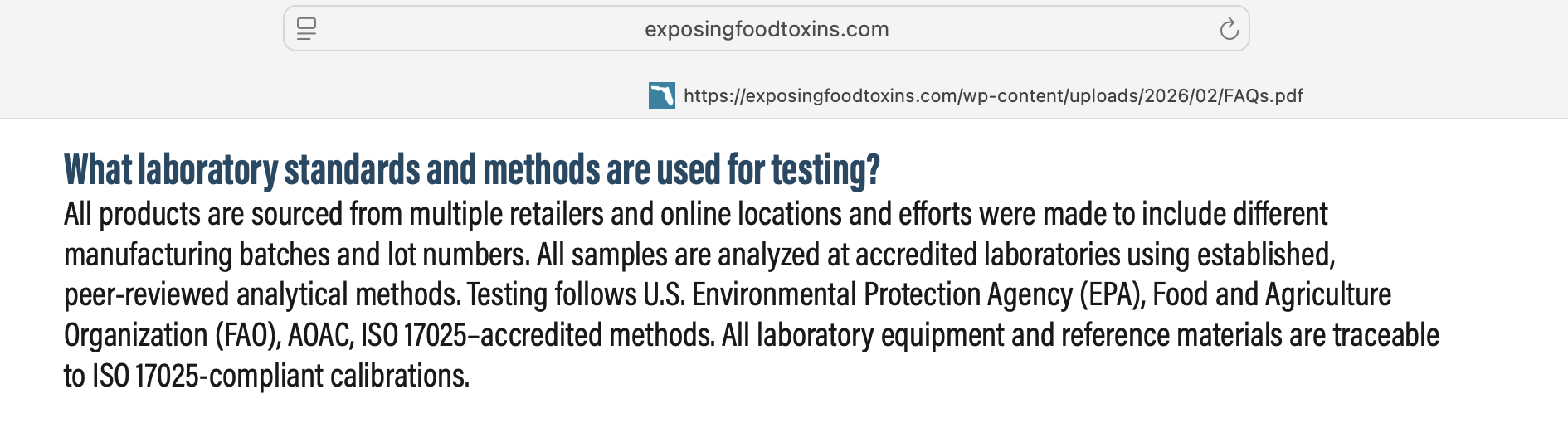
- Specifically, we saw one report online indicating that the State of Florida initiative may have used a lab focused on soil testing (for agricultural purposes) which could have thrown off / invalidated the matrix related to Arsenic detection (as well as the detection of other heavy metals) in the products they tested.
- While we have not yet been able to confirm this, there is some language on their website which supports this as a possibility. See screenshot below:

- Specifically their assertion of high levels of Mercury found in Bobbie products (and any powdered infant formula products really) was completely inconsistent with the extensive testing we have had done on these powdered infant formula products to date.
- Another data point which highlights our concern for the validity of the testing and reporting done by the State of Florida (especially absent them sharing their full original lab reports with the exact testing methodology used for each product tested) was that they found KitKat candy bars to test positive for a significant level of Arsenic, (230 ppb) when our testing and reporting for this product (and other products with similar ingredients) found no Arsenic detected.
- Specifically our test result for the KitKat product was “non-detect” with a reading of “<10 ppb Arsenic.”
- We also tested a SweetTarts product: Florida listed high levels of Arsenic in two products from this brand (400 ppb and 390 ppb), while our testing and reporting on a product from this brand (with a similar ingredient profile to the products they tested) found no Arsenic detected (again with a low threshold of detect of 10 ppb Arsenic, so the result was “<10 ppb Arsenic”.
- In at least one instance, their ExposingFoodToxins dot com website does reference EPA drinking water standards — and we suspect the misinterpretation of the data may stem — in part — from a misinterpretation of those standards (applying the standards and maximum daily limits for Arsenic in water to foods).
That said – we applaud the State of Florida for attempting to quantify the concerns, but think (based on these 2026 lab test results for all four Bobbie products, combined with the other considerations noted above) — they need to get a better handle both on the type of lab testing they are doing (including the types of labs they are using) and the inaccuracies in how they are communicating the science (specifically the ppb levels they have communicated for Arsenic — even if they are correct, which we don’t believe they are — don’t translate into the annual safe consumption limits they are alleging in their info graphics).
Based on the above concerns (including possible inaccuracies and lack of specificity in the State of Florida testing), we also undertook this testing of the Bobbie Infant Formula products at this time in part in an effort to untangle the misinformation being shared by the State of Florida. Products tend to test similar batch-to-batch, within a range of detection levels .
While batch-specific variation is possible (and one should keep an eye out for factors that can impact batches – causing them to have different levels of toxicants than other batches of the same product), batch-specific variation of products made in the same factory, using the same equipment and same ingredients usually falls within a certain range. If a batch test falls outside of a specific expected range (based on historic testing, with all other factors expected to be the same), in addition to reviewing possible ingredient contamination anomalies, one always needs to examine the testing methodologies (and testing facility) as potentially impacting the reported results. This is why Florida’s KitKat results served as a major red flag for us, inspiring us to want to re-test the Bobbie Infant Formula products as a priority.
Section #4) Just Add Water…
Separate from the concern for potentially improper testing methodologies (absent the full original lab reports being shared by the State of Florida) — is what we feel is a significant misrepresentation of the ostensible concern for low (unavoidable) levels of toxicants found in powdered infant formulas that are otherwise considered to be “safe by all standards” (including the standards proposed with the Baby Food Safety Act of 2021).
- The Florida initiative has evaluated and shared the toxicant profiles of these Infant Formula products without appropriate context.
- Specifically, to assess any actual risk presented by infant formula consumption, the product needs to be evaluated as it would be consumed — when mixed with clean (filtered) water.
- First and foremost, any parent feeding their child with a powdered formula product needs to have their water source tested to confirm it falls below 1 ppb Lead.
- Educating families about the importance of using clean (filtered) water to mix their baby’s formula should be a key point addressed by OBGYNs, Pediatricians, Birthing Centers, Maternity Clinics, and Hospitals with Birthing Clinics.
- If water from a household source that parents intend to use for making their baby’s formula does not test at “less than 1 ppb” for Lead, water used for formula for infants must be filtered with a known effective filtration system.
- We recommend using an under sink filtration system (with at least three filtration cartridges) that goes direct to a drinking water faucet at the kitchen sink.
- Filtration cartridges should be chosen to address the specific concerns for water contamination in your area and may include:
- A filter for Lead
- A filter for Chloramine (or Chlorine, depending on how your water system is treated by your city, or county), and then
- A general Carbon filter as well.
Any powdered infant formula product that tests “safe by all standards”, with the standards including those proposed with the Baby Food Safety Act of 2021, will also test even cleaner (if lower thresholds of detection were to be used with appropriate independent, third-party lab testing), when prepared with known clean (filtered) water that is non-detect for heavy metals with a low threshold of detection below 1 ppb.
As the Florida initiative is not sharing their infant formula test results with this context, it is generating quite a bit of concern for families using other formulas that, like Bobbie, are also “safe by all standards”, especially when taking into account this context.
While there is no safe level of Lead exposure for human beings, and while we understand and agree that the impact of lead over a lifetime is cumulative — too many agencies have been sharing the heavy metals test results for dry powdered infant formula products without the correlative context of what the test results might be / should be when the product is prepared — and specifically when the powder is mixed with clean / filtered / safe water. This includes the State of Florida assessment of the concern as well as recent published summaries (over the past couple of years) from Moms Across America and Consumer Reports Magazine.
Section #5) Some Concluding Thoughts
We don’t want to engender fear and panic in new parents, we want to give them science-backed data to help them make informed choices for their families. This includes being clear about the fact that adding clean water will dilute the toxicant levels for any dry powder infant formula, bringing the resultant toxicant level in the finished product to far below any levels of concern in most cases — especially with infant formula powder products for which the toxicant profile for the dry powder alone already falls below the 2021 proposed action levels.
FEED YOUR BABIES everyone!
Test your water.
Use lab tested safer choices for your infant’s nutrition (ask to see the lab reports) and don’t worry.
Thank you also to Bobbie for being brave enough to fund our testing and reporting on their products (it’s not every company that will have enough confidence in their products to support our work in this way!)
While we are confident in our lab and confident that the testing methodologies used are appropriate for the products we have tested — there was a chance (however slight) that our findings could have been in alignment with Florida’s findings. This did not happen — and this new data set for all four Bobbie products (tested in March of 2026), sheds further doubt on the testing and reporting being done by the State of Florida for these same products.
Further comprehensive comparative testing of products tested by the State of Florida needs to be done in an effort to better assess what they may be doing incorrectly to come to the conclusions they are drawing through their initiative. To this end we have reached out to them to see if we can help in some way, but we did not hear back.
We have plans to test the Strawberry Twizzlers and the Jolly Ranchers in Sour Green Apple (each tested and found to have high levels of Arsenic by the State of Florida), to further document any potential disparities in the test results published by the State of Florida. If you would like to help with that initiative we encourage you to consider making a one time gift in support of our work (here’s our general GoFundMe campaign link) and to join us on Patreon with a small monthly gift in support of the Lead Safe Mama, LLC Community Collaborative Laboratory Testing Initiative. Here’s that link.
Thank you for being here!
Thank you for being part of our community!
–
Tamara Rubin
& The Lead Safe Mama Team
Amazon links are affiliate links. If you purchase something after clicking on a Lead Safe Mama, LLC Amazon affiliate link – we may receive a percentage of what you spend at no extra cost to you.

Never Miss an Important Article Again!
Join our Email List